

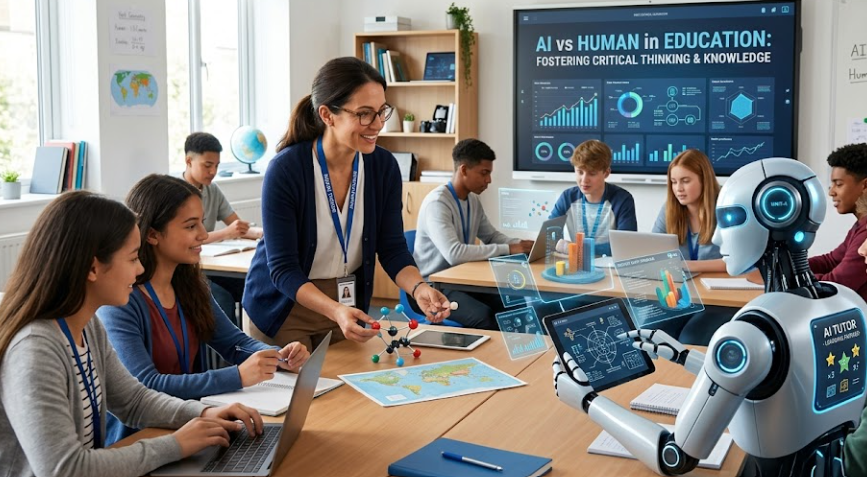
The future of education is not about choosing between AI and teachers. Instead, it is about leveraging AI to enhance teaching while preserving the uniquely human qualities that educators bring to learning environments.
AI excels at automation, data visualisation, and routine information delivery. Humans excel at empathy, critical mentorship, inspiration, and community building. To successfully navigate this disruption, educational institutions and concerned elites should move past the binary narrative of “Human vs. AI” and implement the following three strategies:
• Institutions should deploy AI primarily to automate grading, administrative paperwork, and lesson scaffolding, thereby freeing up “human bandwidth” for face-to-face mentoring and pastoral care.
• General-purpose chatbots should be eradicated in favour of education-specific AI tools designed to prompt step-by-step reasoning and scaffolding rather than providing direct answers.• Align institutional policies with UNESCO’s AI Competency Framework for Teachers, ensuring that human accountability and ethical evaluation remain the final authority in every classroom.
Introduction
Techno-optimists (individuals who believe that technological progress can solve virtually all problems facing humanity) envision a future of autonomous, hyper-personalised digital tutors; empirical data tells a vastly different story.
Available data from major 2023 and 2026 educational reviews—including UNESCO Guidance for Generative AI in Education, UNESCO’s landmark volume AI and the Future of Education, and Stanford University’s SCALE Initiative—demonstrate that AI is not replacing teachers and should not. Instead, it is shifting the teaching profession from an information-delivery model to an AI-augmented, relational framework. So, from this perspective, the question is no longer whether AI will replace teachers, but how teachers will be skilful at orchestrating AI to enhance human-centred learning.
The Data: AI Performance vs. The Human Premium
To aid a clear understanding of why a total replacement of teachers is structurally and pedagogically impossible, we must analyse current causal data across the following three pillars:
cognitive durability, infrastructural realities, and the relational premium.
- Cognitive durability: The most valuable learning outcomes are backed up by durable cognitive abilities, which include critical thinking, problem solving, creativity, ethical reasoning, and the ability to apply newly acquired knowledge to real-life situations. While AI can generate explanations, give relevant examples, and provide feedback, human teachers or facilitators are needed to develop the enduring capabilities that require learners to struggle, reflect, question, and make sense of ideas. Hence, teachers design experiences that cultivate cognitive durability, ensuring students build understanding that lasts beyond the immediate task or assessment.
- Infrastructure reality: Education systems are shaped not only by technological capability but also by the practical realities of their infrastructure. Rapid advancements in innovations require reliable access to technology, connectivity, appropriate devices, and increasing institutional support in their deployment. In reality, these conditions vary widely across schools, regions, and countries. Budget constraints, digital inequities, data privacy requirements, and teacher training all influence how effectively AI can be implemented.
- Teaching is fundamentally relational, and the affective domain of learning emphasises this fact: Students learn more effectively when they feel known, supported, challenged, and encouraged by a trusted adult. Teachers and facilitators are the real architects of learning environments that build motivation, confidence, a sense of belonging, and resilience in students through daily interactions that extend beyond delivering content. Teachers notice subtle signs of confusion, mediate conflict, celebrate little progress, and adapt their approach to individual learners’ styles. These human relationships create a relational premium that technology can support but not fully replicate.
The Paradox of “Autonomous” Learning
A common argument for AI replacement is the efficacy of AI-powered personalised tutoring. However, empirical research reveals a stark “transfer gap.”
The Stanford SCALE Initiative (2026 Review)
In an analysis of over 800 academic papers on K-12 AI integration, the review identified 20 high-quality studies that rigorously measure how AI tools affect outcomes not for students alone but also for educators. Researchers found that while AI tools significantly boost immediate student performance in quantitative subjects and tasks such as writing and coding when students have active, unrestricted access, these gains frequently weaken or disappear when students’ access to AI tools is removed or restricted.
Cognitive friction is very important in the learning process because it forces the mind of the learner to work, which often leads to productive struggle that strengthens understanding, memory, and knowledge transfer. AI tools often reduce cognitive friction too much. Without a teacher to introduce strategic difficulty, AI tutoring can lead to “polished but thin” outcomes, sacrificing deep, durable thinking for immediate correct answers.
The Myth of the Teacher-Substitution Model
Historical and contemporary data consistently show that when technology is used to substitute for a teacher rather than supplement them, learning outcomes drop.
GenAI Tutors
Randomised Controlled Trials (RCTs), also known as multiple randomised controlled trials on GenAI tutors documented between 2023–2026, indicate that a GenAI tutor can outperform traditional instruction, but this depends heavily on design quality and how it is administered- an unguided GenAI tutor shows a negative effect. Meanwhile, meta-analyses on RCTs (2026) report only the immediate learning outcomes, not retention or transfer of knowledge.
The Relational and Ethical Deficit
Teaching is fundamentally a non-algorithmic profession. Data regarding student well-being and pedagogical efficacy confirms that machines cannot replicate human care.
UNESCO’s global data, which includes its recommendation on Ethics of AI (2021), UNESCO Teacher Task Force Projections (2023 – 2025), UNESCO Global Education Monitoring (GEM) Reports, and SDG4 teacher-supply assessments, emphasises a critical gap: 44 million primary and secondary teachers are needed globally by 2030. This shortage cannot be solved by digital deployment because AI systems cannot replicate emotional intelligence, context-sensitivity, cultural transformation, and ethical reasoning.
Pre-service Teacher Perceptions (2026 Studies)
Data evaluating digital-native, upcoming educators shows widespread willingness to adopt AI for administrative relief (lesson planning, rubric generation), but universal scepticism regarding AI’s ability to navigate complex pastoral, emotional, and behavioural disorders (EBD). The study strongly rejects any narrative that AI could replace teachers; instead, future teachers want pedagogically grounded, ethically governed, and teacher-controlled AI tools.
The Actual Transformation: Structural Shift, Not Replacement
Available data suggests that instead of erasure or replacement, the teaching profession is undergoing a macro-evolution. Using a bibliometric analysis tool to track hundreds of education documents over the last three years, the discovery highlights a clear trajectory of the human teacher’s role:
| Era | Primary Role of the Teacher | AI Tech Integration |
| 2023 to 2024 | Advanced from Technological Adopter role to Mediator of Ethics & Integrity | Navigating plagiarism and over-reliance. Setting classroom AI guardrails. |
| 2025 to 2026 | Architect of AI-Learning Environments | Designing and emphasising workflows where AI manages data, humans manage care and culture |
Fact
Findings from exploring the Dynamic Capabilities Theory applied to education, which centres on how an educational institution adapts, innovates, and transforms in response to rapid environmental change, including technology, policy, and learner needs. Teachers’ fears are rarely about being “replaced” by a machine; rather, they stem from institutional strain—the imbalance between rapid technological requirements and the lack of professional AI literacy training.
Conclusion
The data-driven insight is clear: AI will not replace teachers, but teachers who use AI efficiently are great and will replace teachers who do not.
Further Reading
i. Wang, C., Sun, N., Pan, X. et al. The impact of integrating generative artificial intelligence into medical education on short-term learning outcomes: a systematic review and meta-analysis of randomized controlled trials. BMC Med Educ 26, 983 (2026). https://doi.org/10.1186/s12909-026-09320-6
ii. The Stanford SCALE Initiative(2026).
iii. Puentedura’s Pragmatic Dreams (TEAL 2021).
iv. UNESCO Teacher Task Force (TTF) 2023 Report: Addressing the Global Teacher Shortage: Teacher Task Force Policy Brief
v. GEM Report 2023/24 (2023): UNESCO Global Education Monitoring Report 2023/24: Technology in Education.
vi. UNESCO SDG4 Data Digest (2023): SDG4 Data Digest: Teachers and Education Workforce Indicators.
Discussion & Contribution
How can AI and teachers work together to improve education?

Leave a Reply